ShareThis

Tuesday, December 17, 2013

Ex-BP Engineer Destroyed Gulf Spill Evidence, Jury Told - gCaptain

Posted - December 16, 2013 - gCaptain - By Margaret Cronin Fisk and Daniel Lawton - Copyright - Bloomberg

A former BP Plc engineer deliberately destroyed evidence sought by the U.S. for a probe of the 2010 Gulf of Mexico well explosion and oil spill, a federal prosecutor said at the end of a trial in New Orleans.
Prosecutors charged the engineer, Kurt Mix, with two counts of obstruction of justice last year, alleging he deleted from his mobile phone text messages and voice mails related to BP’s effort to estimate the size of the spill. Mix was a senior engineer involved in leading efforts to cap the Macondo well as crude gushed into the gulf.
“Kurt Mix knew exactly what was on that text message string when he deleted it on Oct. 4 and 5 and intended to obstruct this grand jury investigation,” Leo Tsao, a federal prosecutor, told the jury today. “The defendant acted with corrupt intent when he deleted text messages.”
The blowout of BP’s deep-water Macondo well off the coast of Louisiana in April 2010 killed 11 people and set off the largest offshore oil spill in U.S. history. BP agreed last year to pay $4 billion to resolve the federal criminal probe of its role in the spill.
The London-based company pleaded guilty to 14 criminal counts including 11 for felony manslaughter, one misdemeanor under the Clean Water Act, one misdemeanor under the Migratory Bird Treaty Act and one felony count of obstruction of Congress for misrepresenting the size of the spill.
Destruction Denied
Mix, the first defendant in a criminal case over the spill to face a jury, was accused of deleting multiple messages, including one in which he said the spill was bigger than the company said it was. Mix denies intentionally destroying evidence and has pleaded not guilty.
“The government’s theory is pure nonsense,” Michael McGovern, Mix’s attorney, told the jury today. “He doesn’t have a corrupt bone in his body.”
Mix is charged with deleting messages on two separate occasions, once in October 2010 involving communications with his supervisor, Jonathan Sprague, and later in August 2011, over exchanges with Sprague and a contractor named Wilson Arabie.
Mix’s lawyers contend there is no evidence that he acted with corrupt intent in destroying messages on either occasion.
“Kurt didn’t have any secret knowledge of flow rate,” McGovern said in his closing argument today. Mix was “open and transparent, through and through,” he said.
Mix was involved in leading BP’s efforts to cap the well, including a procedure called Top Kill, the U.S. said in court papers. Mix had access to internal company data on the amount of oil flowing into the gulf.
‘Well Above’
He knew that BP’s internal estimates of the flow rate were “well above” the numbers the company was citing publicly and higher than the maximum 15,000 barrel-a-day limit for Top Kill to succeed, the U.S. said.
Mix didn’t disclose this at a meeting of government officials and BP engineers in May 2010 and subsequently erased references to it on his iPhone, prosecutors said.
He sent a text message to a supervisor on May 26, 2010, saying that the flow rate was too high for Top Kill to work, Federal Bureau of Investigation Special Agent Barbara O’Donnell said in a sworn statement filed in the case.
“Too much flow rate — over 15,000 and too large an orifice,” Mix said, according to the U.S. He later deleted the text, O’Donnell said. The U.S. was able to recover most of the texts, including this one, using “forensic tools,” she said in an April 2012 filing.
Flow Rates
Mix shouldn’t have been indicted and was wrongly cast by the government as a central player in a BP cover-up, his lawyers said in court filings. They also contend the 2010 deletion occurred before a grand jury investigation began and the 2011 messages had no relevance to flow rate estimates.
Mix “repeatedly shared with the government, all through the Macondo response effort, the very same information that these prosecutors claim he was trying to hide,” Joan McPhee, Mix’s lawyer, said in her opening statement Dec. 3.
Mix deleted some messages, “but that is not the issue in this case,” she said. He wasn’t intending to hide anything, McPhee said. “He had nothing to hide because he had done nothing wrong,” she told the jury Dec. 3.
BP told Mix to retain all records related to the Macondo well incident, including text messages and voice mails, Tsao, the prosecutor, told the jury today.
“It’s simply beyond reason that Kurt Mix in good faith thinks he actually complied with the legal hold orders,” Tsao said.
“When a person destroys evidence to keep it from the grand jury, that undermines the very system of justice itself,” the prosecutor said. “It’s a crime and Kurt Mix should be held accountable.”
The case is U.S. v. Mix, 12-cr-00171, U.S. District Court, Eastern District of Louisiana (New Orleans).

Post to be found at:
http://gcaptain.com/ex-bp-engineer-destroyed-gulf-spill-evidence-jury-told/?utm_source=feedburner&utm_medium=feed&utm_campaign=Feed%3A+Gcaptain+%28gCaptain.com%29
TopOfBlogs

Thursday, December 12, 2013

Post’s and Items December 12 - Update - Wordsmith

Post’s and Items December 12  - Update


The Herald | HeraldOnline.com (press release)
 - ‎9 hours ago‎


“Fire foam storage containers can operate under harsh environmental conditions in ships, terminals, offshore platforms, and airports.

MarineLink
 - ‎ ‎


The new Mobil SHC Aware range has been formulated to not only help engineers comply with the new marine operating practices, but to enhance vessel reliability, minimize maintenance costs and reduce potential environmental impact. The Mobil SHC ...
Automation World


AIS marine monitors and computers comply with marine equipment standards IEC 60945, DNV 2.4, and IACS-E10 needed to withstand harsh maritime environment requiring low EMI or long-term vibration resilience. AIS Ruggedized Computer Displays for ...


MarineLink
 - ‎ ‎


The slick itself, regardless of the toxicity or biodegradability of the oil in the event of a spill accounts for much of the initial mortality in marine wildlife in the initial stages of the discharge. One of the reasons the U.S. EPA enacted the 'Clean ...
The Maritime Executive


As the EU Year of Air comes to a close, leading green and health NGOs wrote to European environment ministers urging them to oppose the Russia-led proposed delay of stricter Nitrogen Oxide (NOx) emissions limits at the International Maritime ...


vtdigger.org


Mr. Bagnato has over ten years of experience in the energy field and was most recently Manager, Environmental Permitting & Compliance, for First Wind, where he oversaw the permitting of wind and solar projects throughout the United States, with a focus ...


Voice of America


"As the security environment surrounding our country is increasingly getting severe, the Abe cabinet has been working on restructuring defense and security policy with our determination to protect the lives and property of people of Japan under any ...

NASDAQ
 - ‎


... operated in accordance with applicable maritime environmental laws and regulations. Mr Zafirakis also noted that the EEMS has been independently audited and certified as being ISO 14001 compliant and that environmental compliance will continue to ...


MarineLink
 - ‎ ‎


If your vessel is trading in U.S. waters, you need to be aware of the new oil to sea interface law that comes into effect on Dec. 19, 2013.

Voice of America
 - ‎ ‎


"As the security environment surrounding our country is increasingly getting severe, the Abe cabinet has been working on restructuring defense and security policy with our determination to protect the lives and property of people of Japan under any ...
Journal of Energy Security
 - ‎ ‎


AddThis Social Bookmark Button. After 9/11, the international community adopted series of regulatory initiatives to counter security threats that exist in the maritime environment and enhance security of the maritime transport industry. .... These ...

Environmental Leader
 - ‎ ‎


The SeaCURE system is designed to comply with International Maritime Organization (IMO) Convention D-2 regulations for ballast water management and received IMO final approval in 2012.
DigitalJournal.com
 - ‎ ‎


In response, the 1992 United Nations Conference on Environment and Development (UNCED) called on the International Maritime Organization (IMO) and other international bodies to take action to solve the problem. By this time, the IMO had been seeking a ...


MarineLink
 - ‎ ‎


Since the IMO (International Maritime Organization)'s announcements about the regulations of ECDIS (Electronic Chart Display and Information System), the challenges in marine software development have become more competitive and dynamic. “Every ...


Saudi Gazette
 - ‎19 hours ago‎


The latest of which was the GCC Defense Ministers' laying of the foundation stone of the coordination center for maritime security in Bahrain. The leaders agreed to establish a joint Gulf police force. ... Abdullatif Al-Zayani, GCC Secretary-General ...
TopOfBlogs

Post’s and Items for December 12 - More to follow - Wordsmith

Post’s and Items for December 12


By 2015, container shipping line APL plans to reduce the emissions of carbon dioxide (CO2) and other greenhouse gases associated with cargo transportation ...

Because much shipping activity occurs close to shore, ship emissions have a significant impact on human health and the environment with studies suggesting ...

The spread of harmful algal blooms and marine pollution are a serious threat to the fishery resources of the Indian Ocean RIM countries. The expansion of these ...

Political Action Project Ocean Pollution 3 .... Tons Radioactive Water Leaks Daily Into Ocean; JP Government Aids Tepcoby MissingSky1013,661 views; 9:33

Kochi: Sounding a warning on the rising pollution in the Indian Ocean, delegates at the ongoing regional workshop on fisheries management, said it was ..
TopOfBlogs

The Technology Required to Contain Subsea Well Blowouts Continues to Evolve - gCaptain

Posted - December 11. 2013 - By Rob Almeida - gCaptain

In November 2010, following the tragedy of the Macondo disaster, the U.S. Bureau of Safety and Environmental Enforcement (BSEE) issued a notice to all lessees and operators working on the outer continental shelf requiring that companies have “access to and can deploy containment resources that would be adequate to promptly respond to a blowout or other loss of well control.”
Anticipating these requirements months earlier, while Macondo was not completely plugged, ExxonMobil, Chevron, ConocoPhillips and Shell got together to form the Marine Well Containment Company (MWCC), an independent entity aimed at coming up with a technical and physical solution to any future subsea oil and gas blowouts should one occur.
By 2011, MWCC had their first working capping stack rated for 15,000 PSI and 250 degrees.
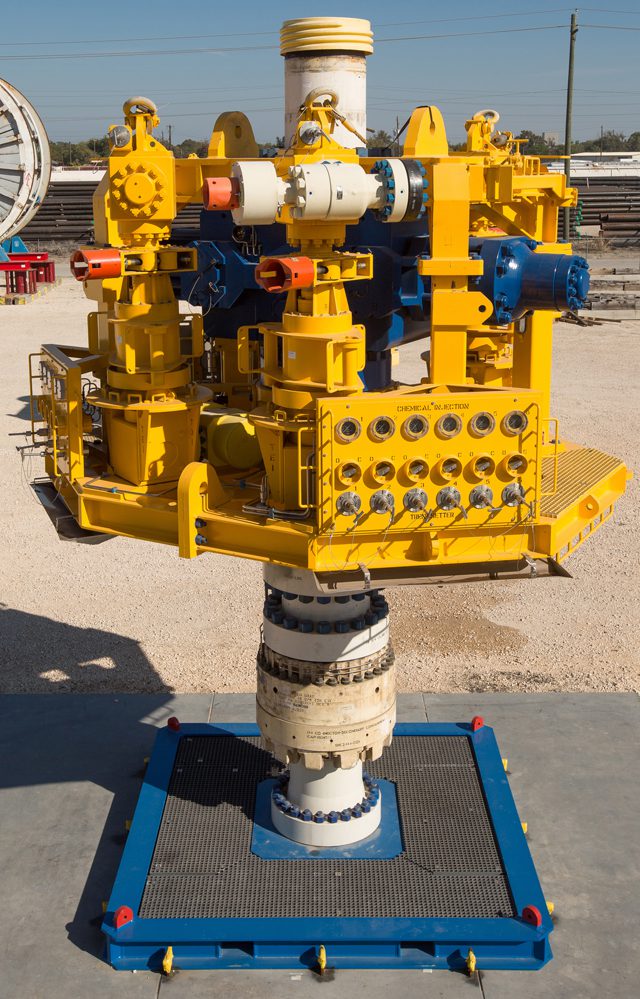
Built by Trendsetter Engineering in Houston, this towing piece of iron stands 30 feet tall, 14 feet wide and weigh about 100 tons.
mwcc capping stack
These dimensions may seem significant, but it’s essentially nothing more than a giant valve designed to mate up perfectly to a subsea wellhead to either shut in the well or redirect the flow of hydrocarbons to a subsea riser system and onward up to a tanker on the surface.
MWCC CEO Marty Massey notes in a phone call today that while they were confident it would work, BSEE did require a demonstration. In a simulated test in 2012, MWCC deployed their capping stack to a simulated wellhead located in 6,900 feet of water in the Gulf of Mexico where they latched on and pressure tested the system. “It worked perfectly,” he commented.
As demands by offshore operators have evolved, MWCC has had to evolve their technology as well. Last month they unveiled their newly up-rated capping stack with the ability to handle upwards of 350 degree fluid temperatures.
This stack is the first of its kind anywhere in the world capable of handling temperatures of 350 degrees F.
“The rerate of the single ram capping stack is another step in MWCC’s commitment to keep pace with member needs as they explore at greater depths, pressures and temperatures” said Marty Massey, chief executive officer of Marine Well Containment Company in an emailed statement.
High pressure, high temperature subsea wells are always a focus for MWCC, but in some cases the sheer size of the capping stack made it more difficult to use. Such issues are inherent to production facilities such as spars or tensioned leg platforms where the wellheads and riser systems are all fairly closely located together. For this issue, MWCC made available a more compact, 50-ton, dual ram, 10,000 psi-rated capping stack.
Looking ahead into 2014, MWCC plans to further evolve this technology with an expanded containment system that incorporates the use of a specially-converted Aframax tanker into a “Modular Capture Vessel,” and an electro-hydraulically operated capping stack capable of operating in 10,000 feet of water at 15,000 PSI and 250 degrees. In addition, this new system will be able to flow upwards of 100,000 barrels per day of fluids, vice the current rating of 60,000.mwcc capping stack

Post to be found at:
http://gcaptain.com/technology-required-subsea-oilwell-mwcc/
TopOfBlogs