ShareThis

Monday, November 25, 2013

Tar Sands Crude Shipping Meets Great Lakes? Opposing report cites gaps in region's oil spill prevention, response - Maritime Executive

Wordsmith - Protecting  the waters of  the Great Lakes must be the the  first and highest priority.

Post starts here:
As tar sands extraction continues and proposals for expanded pipelines from Canada into the U.S. form a backdrop, the Great Lakes themselves could become the next frontier for moving crude oil to a vast Midwest refinery network.

The region faces a critical choice about whether the Great Lakes should become a thoroughfare for tar sands crude shipping, a new Alliance report warns. The report finds that neither the Great Lakes shipping fleet nor its ports were designed to ship tar sands crude over the Great Lakes, and cites serious gaps in the region’s oil-spill prevention and response policies.

Already, plans are in the works to dramatically increase the flow of tar sands crude to the Midwest as early as next year; permitting is sought for a $25 million loading dock on Lake Superior to ship the crude in 2015; and a tar sands shipping route has been mapped across the waters of the Great Lakes.

“We're at a crossroads now, with companies starting to seek permits for new oil terminals,” says Lyman Welch, director of the Alliance’s Water Quality Program and the report’s lead author. “Before our region starts sinking money into shipping terminals for the Great Lakes, our task should be to ask ‘if’ rather than ‘when.’”

Western Michigan residents learned firsthand the risk of mixing tar sands oil with water in 2010 after a cataclysmic pipeline spill in the Kalamazoo River. Three years and $1 billion-plus worth of cleanup later, more than 20 percent of the oil spill remains at the bottom of the river:  a heavy, viscous muck synonymous with this form of crude oil.
The report questions the rush to capitalize on the growing flow of tar sands oil, destined for 19 U.S. and Canadian refineries on or near the Great Lakes and St. Lawrence Seaway. Enbridge, responsible for the Kalamazoo spill and owner of pipelines to several of these refineries, plans next year to expand its pipeline to Superior, Wis. to accommodate another 120,000 barrels per day, up from 450,000. As companies jockey to take advantage of the demand for this unique and significantly cheaper crude, pressures are also mounting to find economical ways to move it out -- and Great Lakes vessel shipping is emerging as a key contender.

“Great Lakers have a track record of making smart choices as a region when the lakes are at risk,” says Welch. “We need to pause for breath and decide which fork in the road leads to a healthy Great Lakes.”

The report’s authors probe deeply into whether regulators tasked with overseeing the health of the world’s largest body of surface freshwater are prepared to safeguard the Great Lakes from a potential tar sands crude spill, and to direct a cleanup should disaster strike. They cite the following shortcomings: 

A recent U.S. Coast Guard and Department of Homeland Security report on spill-response protocols for submerged oil found current methods for locating and recovering submerged oil inadequate.

A “Worst-Case Discharge” scenario developed by the Coast Guard involves a Great Lakes vessel carrying a type of oil that is much different, and less damaging to the environment, than tar sands crude.

Limited resources are available to learn about the risk of oil spills by vessels and oil-spill management in the region; most information about spills is outdated or discontinued.

“The current regulatory net has far too many holes,” the report says. “The regulatory and response framework for petroleum shipping on the Great Lakes is not fully up to the task of protecting the lakes from spills today, and is certainly not an adequate starting point from which to consider the viability of tar sands crude shipment by vessel.” 

Noting the Great Lakes provide more than 40 million people with drinking water, the report stresses the importance of strengthening efforts now to prevent a potential Great Lakes oil spill. 

Among its recommendations are that the U.S. improve coordination among federal agencies involved in large-scale spill prevention and response, with a special emphasis on tar sands crude and other “submerged” oil spills. The report also calls on Congress to increase funding for prevention, preparedness and response programs, and on Great Lakes states to expand and enhance state laws to prevent and better protect their shorelines from oil-shipping spills.

For their part, the report says tar sands crude shippers should improve safety and maintain spill-prevention and response equipment.

“The movement of oil across water increases the risks of oil in water, a clash in which the environment is the loser,” the report states. “We must preface our choice of whether to ship tar sands crude by vessel with proactively improving our oil-spill prevention and response policies. The health of the Great Lakes is at risk unless we take swift action.“

Posted - November 22, 2013
Post to be found at:
http://www.maritime-executive.com/article/Tar-Sands-Crude-Shipping-Meets-Great-Lakes-2013-11-22/
TopOfBlogs

Lab Fish Fed Plastic More Likely To Develop Tumors, Liver Problems - Northwest Public Radio

Posted - November 22, 2013

Scientists have photographed dead whales and seabirds, their stomachs filled with plastic bags and bottle caps. But those larger chunks eventually break down. In fact, the majority of plastic pollution in the ocean, by volume, comes in the form of tiny confetti-sized particles. They’re commonly found in Puget Sound. And new research shows that when fish eat particles of plastic the results aren’t good.

Credit epSos .de/Flickr 
 
The plastic in the ocean acted sort of like a poison pill for fish, sopping up those pollutants.
Chelsea Rochman compared three groups of Japanese medaka, the “lab rat” of fish. Rochman is a postdoctoral researcher at the University of California, Davis in the School of Veterinary Medicine. She fed one group regular fish food. In the other 2 groups Rochman substituted in 10% clean plastic and 10% plastic that had been submerged in San Diego Bay for several months. In the ocean chemicals – like flame-retardants and PCBs – latch on to floating plastic. After two months the fish in Rochman’s lab were analyzed for levels of those chemicals in their bodies.
Rochman: “We did find that the chemicals do transfer from the plastic to the fish and we saw a greater concentration in the fish that ate the plastic that had been in the ocean than the fish that had eaten the virgin plastic or the controlled diet.”
In other words, the plastic in the ocean acted sort of like a poison pill for fish, sopping up those pollutants. Rochman found that the fish that were fed plastic developed liver problems and showed signs of tumor development. It’s unclear if these health effects are happening in fish in the Northwest, but Rochman’s research suggests these chemicals could be making their way into the food chain. Her research was published in the journal Nature Scientific Reports.

Post to be found at:
http://nwpr.org/post/lab-fish-fed-plastic-more-likely-develop-tumors-liver-problems
TopOfBlogs

Friday, November 22, 2013

More on the Pipeline Explosion - South China Morning Post

Posted - November 22, 2013 - Patrick Boehler and Sue Su - South China Morning Post

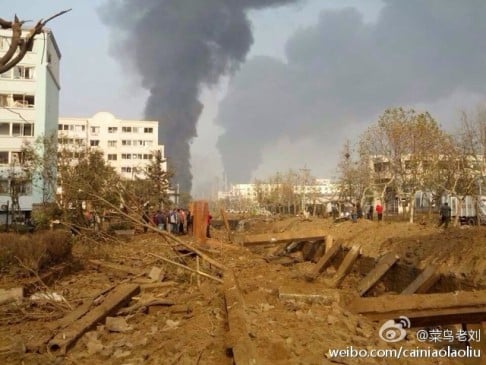
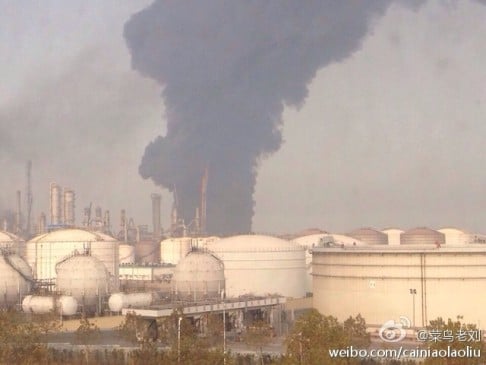
The death toll from a massive explosion that shook the northern Chinese port city of Qingdao has risen to 35, reported state-owned China Central Television (CCTV) on Friday afternoon, making it one of the most deadly industrial accidents this year.
fire.jpg
http://www.scmp.com/sites/default/files/styles/980w/public/2013/11/22/fire.jpg?itok=V2Y8f0dg

CCTV online updates reported that as of 5.40pm on Friday, at least 166 people were injured and in hospital. The powerful explosion occurred near the southern gate of the Lidong Chemical Plant in the city's Huangdao district in the morning. Xinhua said it was still verifying other casualty counts.
An underground oil pipeline ruptured at around 3am, causing an oil spill, the Qingdao municipal government said. The emergency repair work that followed led to a fire and caused the explosion, it said. Two separate fires were extinguished by 1pm.

The ruptured pipeline was part of a 176-km underground pipeline project that pumps crude oil from Qingdao to Weifang, also in Shandong Province. Xinhua says the pipeline was operated by oil giant Sinopec.
Crude oil leaked by the pipeline spilled into the harbour basin near Jiaozhou Bay at 3am in the night to Friday, according to a preliminary report by the Qingdao Municipal Environmental Protection Bureau. The operating company stopped the oil flow in the broken pipeline around 3.15am and attempted to contain the contamination of several hundred square meters large area of polluted water. Contamination at sea extended over three square kilometres, the report said.


http://widgets.scmp.com/video/video_iframe.php?id=%20624186&movideo_m=624186

Oil that entered local rain drainage pipes exploded at 10.30am, the report said.
Pictures published by local media and witnesses on the social media platform Weibo show corpses, damaged streets and overturned vehicles. One picture, purportedly published by an passenger on board an airplane which was flying over Qingdao after the explosion showed black smoke rising through the sky

Post to be found at:
http://www.scmp.com/news/china-insider/article/1362729/three-dead-48-injured-explosion-qingdao-industrial-area
TopOfBlogs

China pipeline blast - ianslive.in

Posted - November 22, 2013 - IANS

Beijing, Nov 22: At least 22 people were killed on Friday morning when a leaking petroleum pipeline caught fire and exploded in the coastal city of Qingdao in China's Shandong province, authorities said.
The number of injured people have not yet been confirmed. They are being treated in local hospitals, Xinhua reported.
The accident happened around 10.30 a.m. in Huangdao district when workers were repairing the petroleum pipeline, which began leaking oil at around 3 a.m., according to the Qingdao government's publicity office.
Oil flow through the pipeline was shut down at about 3.15 a.m. The fire was put out, and barricades were set up to stop the oil from entering the sea, according to a comment posted Friday on the official microblog of the Qingdao municipal environmental protection bureau on Sina Weibo, China's Twitter-like microblogging service.
The 176-km pipeline, which links oil depots in Huangdao to Weifang city, home to a few petrochemical plants, is owned by Sinopec, China's largest oil refiner.
Pieces of cement and debris were scattered around the explosion site, which is close to the coast.
No new oil leakage from the pipeline had been found, according to a Xinhua reporter at the scene.
According to the city's maritime safety administration, there has been no report on blast-related pollution in the sea so far, but they have strengthened patrolling around the coastal areas close to the blast site.
The cause of the accident is under investigation.

Post to be  found at:
http://www.ianslive.in/index.php?param=news/China_pipeline_blast-403776/LatestNews/31

TopOfBlogs

BSEE Cites 12 Offshore Operators for Compliance Failures - Maritime Executive

Posted - November 21, 2013 -  Maritime Executive

Bureau of Safety and Environmental Enforcement (BSEE) Director Brian Salerno cited 12 offshore operators for their failure to demonstrate compliance with the Safety and Environmental Management Systems (SEMS) requirements of the Workplace Safety Rule, 30 CFR Subpart S. The SEMS requirements were put in place in October 2010, following the Deepwater Horizon oil spill.   Per the regulations, offshore operators were required to complete an initial SEMS audit by November 15, 2013.  

"An effective, fully implemented SEMS program is essential to reducing risks across offshore operations," said Director Salerno. “BSEE must be assured that companies are addressing the key elements of SEMS and that they are not needlessly putting their workers and the environment at risk.  We will vigorously enforce compliance with this fundamental requirement." 

Beginning Nov. 16, Director Salerno directed five companies to halt operations because they failed to provide the Bureau an audit plan and completed audit by the Nov. 15 regulatory deadline, calling into question whether they have implemented a SEMS program. The companies were given three days to reach a safe point in their operations before ceasing work. While most of the companies are conducting plugging and abandonment or other decommissioning activities, the elements of a SEMS program are applicable to all offshore operations. The Bureau has determined that the impact of this enforcement action on Gulf of Mexico production is minuscule. 

Seven additional companies submitted audit plans that were in compliance with regulations, but failed to complete the audits before the Nov. 15 deadline. Those companies have been directed to immediately provide BSEE with a copy of their SEMS program; have the company Chief Executive Officer certify, under penalty of perjury, that their company has implemented the SEMS program; and complete their SEMS audit without further delay. BSEE may take other enforcement measures, including the assessment of civil penalties for each day of non-compliance, if operators do not meet these requirements. 

The Bureau took these actions only after repeated notifications via email and letters to the companies during the past year, reminding them of the deadline and offering to work with them to ensure they understood the requirements. The Bureau also offered to waive the requirement to submit an audit plan 30 days before conducting the audit in an effort to encourage operators to complete their audits in advance of the deadline. 

Eighty-four operators were subject to the Nov. 15, audit deadline, and 72 completed an initial audit. BSEE will analyze the audit reports and work with companies to ensure their corrective action plans adequately address noted deficiencies and provide for continuous improvement across all offshore operations. 

BSEE's predecessor agency, the Bureau of Ocean Energy Management, Regulation and Enforcement (BOEMRE), published the Workplace Safety Rule in October 2010, requiring offshore oil and gas operators to develop and maintain a SEMS program. The SEMS program is designed to reduce the risks of accidents, injuries and spills that occur in connection with offshore oil and gas exploration and development activities on the Outer Continental Shelf.

For more information about the SEMS program and requirements, click here.  

To view the letters sent to the companies, click here.

Post to be found at:
http://www.maritime-executive.com/article/BSEE-Cites-12-Offshore-Operators-for-Compliance-Failures-2013-11-21/
TopOfBlogs

Wednesday, November 20, 2013

Options Narrowed, U.S. Is Said to Weigh Destroying Syrian Chemicals at Sea - New York Times

Posted - November 19, 2013 - By Thom Shanker & Eric Schmitt - New York Times

WASHINGTON — Unable to find a country willing to dispose of Syria’s chemical weapons, the United States is considering plans to place the chemical components of the weapons on a barge where they would be dissolved or incinerated, according to senior American officials. 

The two systems under review are intended to destroy the precursor materials that are designed to be combined to form chemical munitions. Syria’s smaller arsenal of operational chemical weapons would be destroyed separately, officials said.
Officials from the Organization for the Prohibition of Chemical Weapons, which is operating in Syria to locate and identify the weapons, would monitor the destruction, which would be carried out following safety standards set by legislation in the United States and the European Union, according to officials familiar with the proposal. Officials did not say whether any chemical residue would be dumped in the ocean.
The system could be operational in 75 days.
The seaborne options have received more serious consideration after Albania on Friday turned down an appeal by the United States to destroy the weapons on its territory; the decision followed street protests by thousands of Albanians. Norway rejected an earlier request, saying it did not have the expertise or the facilities to destroy the weapons. The issue caused a major political dispute there as well.
Under one plan, five incinerators operating at temperatures of 2,700 degrees aboard the barge would be able to destroy all of Syria’s most serious precursor materials for chemical weapons in less than 60 days. Officials said the byproducts would be harmless salts and other solids.
No American companies, ships or personnel would be involved under this proposal, although officials said it was possible that the American military would help provide security in the international waters where the barge would be situated, whether by assigning warships or surveillance planes to the mission.
The second proposal focuses on a highly sophisticated mobile system developed by the Pentagon, known as the Field Deployable Hydrolysis System, which is designed to convert chemical agents into compounds that cannot be used for military purposes by mixing them with water and other chemicals and then heating them, American officials said.
The system, which the Pentagon says can be operated within 10 days of being shipped to a new location, would be used to neutralize the large quantities of precursor chemicals that could be used by the Syrian government to make sarin and other forms of poison gas and thus replenish its chemical weapons arsenal.
Secretary of State John Kerry, according to administration officials, was referring to the two proposals in remarks on Monday when he was asked whether the effort to destroy Syria’s chemical weapons, as mandated by the United Nations, had stalled.
“We are not without other alternatives,” he said. “In fact, we are actively pursuing two other alternatives which provide us a complete capacity to do the destruction and to meet the schedule.”
Mr. Kerry praised the process now underway as “a remarkable event.”
“The chemical weapons of one country are being corralled and moved and contained and placed under the supervision of an international organization which is committed to removing those weapons from Syria by the end of the year,” he said. “And I believe we are on target currently to achieve that.”
Administration officials said on Tuesday that the proposals represented an effective solution to the question of how the weapons would be destroyed once they were removed from Syria.
“These are among the options we are considering, as we have unique capabilities that can be applied to the disposition” of Syrian chemical weapons, said Caitlin Hayden, a spokeswoman for the National Security Council.
Another senior official said the option of destroying the munitions at sea was “logical.” “There’s convincing evidence that these options would render the chemicals neutral at sea,” said the official, who spoke on the condition of anonymity because the final means of destroying the chemicals have not been decided.
But the official said the United States had not given up on finding a country that would accept the 1,000 tons of precursors and other chemicals in Syria’s arsenal, where the Organization for the Prohibition of Chemical Weapons would oversee the chemicals’ destruction.
The important step now, the official said, is to secure the chemicals — now stored mostly in one-ton and two-ton containers — and transport them safely to a Syrian port for loading onto one or more ships.
“The key now is to get it onto a ship and get it out of the country,” the administration official said, noting that the weapons could be kept there for days or weeks until a decision is reached to either take them to a country for destruction or to neutralize them at sea.
By destroying the weapons in international waters, the effort would not require approval by any particular country, but environmental activists might voice opposition.
American officials remain concerned that the Syrian chemical weapons will be vulnerable to attack and possible seizure as they are transported from their storage sites to a port over roads that are battlegrounds today.
Security for the shipments is being provided entirely by Syrian military units loyal to President Bashar al-Assad, who has surprised American officials with how speedily he has complied with an agreement brokered by Russia to identify and turn over his chemical weapons stockpiles.
Syria has agreed to a deadline of Dec. 31 for destroying the most critical material, and Feb. 5 for most of the rest.
The Organization for the Prohibition of Chemical Weapons, which announced the plan for removing the materials late on Friday, is expected to train Syrian forces to package, seal and safeguard the containers for transportation in truck convoys to the port from 23 declared weapons sites. 

Post to be found at:
http://www.nytimes.com/2013/11/20/world/middleeast/us-weighs-destroying-syrian-chemicals-on-barge-officials-say.html?ref=middleeast&utm_source=Sailthru&utm_medium=email&utm_term=*Mideast%20Brief&utm_campaign=Mideast%20Brief%2011-20-2013&_r=0
TopOfBlogs

Pollution From Plastic Trash May Make Tiny Island a Superfund Site - e360 digest

Posted - November 19, 2013 - e360 digest -

The U.S. Environmental Protection Agency plans to study whether plastic pollution on a small island in the Pacific Ocean is severe enough to warrant listing it as a Superfund clean-up site. Tern Island, a 25-acre strip of land about 500 miles northwest of the Hawaiian island Oahu, is home to millions of seabirds, sea turtles, and the endangered Hawaiian monk seal. The U.S.-based Center for Biological Diversity asked the EPA to add the entire Northwestern Hawaiian Islands and parts of the so-called Great Pacific Garbage Patch to the list of federal Superfund sites due to extreme marine debris pollution, but the agency has only agreed to undertake an environmental study on Tern Island.
Tern Island debris

Tern Island marine debris

The island is awash with marine debris ranging from plastic water bottles and tiny bits of plastic to discarded fishing gear and home appliances. Studies have shown the trash can take a heavy toll on wildlife — seabirds, for example, often ingest bits of plastic after mistaking them for food and eventually die of starvation. The EPA study is the first step of a potentially years-long process to determine whether the island qualifies for listing under the Comprehensive Environmental Response, Compensation, and Liability Act of 1980.

Post to be found at:
http://e360.yale.edu/digest/pollution_from_plastic_trash_may_make_tiny_island_a_superfund_site/4006/
TopOfBlogs