ShareThis

Monday, December 2, 2013

New Terntank tankers will feature the first Wärtsilä 2-stroke, low pressure, dual-fuel engines - Hellenic Shipping News Worldwide

Posted - December 2, 2013 - Hellenic Shipping News Worldwide

Wärtsilä, the marine industry’s leading provider of innovative products, solutions and services, has announced that its new 2-stroke, low pressure, dual-fuel engine has been selected by Terntank Rederi A/S, the Denmark based tanker operator, to power two new environmentally advanced, 15,000 DWT tankers. These will be the first installations of this engine.

The new Wärtsilä technology was just recently introduced at a customer event held at the company’s Trieste, Italy facilities on November 12. The first engine utilising this technology is the Wärtsilä RT-flex50DF.

The significance of the availability of low pressure, dual-fuel engine technology for 2-stroke engines is that it provides notable economic and environmental advantages over other technologies. The new engine is IMO Tier III emissions compliant in gas mode without need of NOx abatement equipment.

The engine will provide capital expenditure (CAPEX) savings of between 15 and 20 per cent compared to other 2-stroke gas engine technologies currently on the market. This is possible thanks to the fact that no exhaust gas cleaning systems are needed and that the LNG and gas handling system is substantially simpler and of lower cost since only low pressure gas compression is required.
Another key benefit is that the Wärtsilä technology allows stable operation on gas across the entire load range, meaning that at low loads, there is no need to switch to diesel.

The selection of the Wärtsilä RT-flex50DF engine is a central feature of Terntank’s ’Into the future - Baltic SO2lution’ project, which is in response to the European Commission’s TEN-T call 2013 whereby “Motorways of the sea actions” are identified to promote the sustainability and safety of transport, and to improve either existing or new maritime links. The project supports the development of more environmentally sustainable and energy efficient shipping in the Baltic Sea region, and the building of an LNG infrastructure. Since the Baltic Sea is a designated Emissions Control Area (ECA), the use of LNG as fuel is seen as being an effective means of attaining cost-efficient regulatory compliance.

When operating in gas mode, nitrogen oxide (NOx) emissions from the Wärtsilä RT-flex50DF engine are at least 85 percent below those specified in the current IMO regulations. CO2 emissions are some 25 percent less than those of a conventional marine engine running on diesel fuel, while the sulphur oxide (SOx) and particle emissions are negligible at almost zero percent.

“These newbuild tankers will be among the world’s most environmentally sustainable ships, and we are very proud of this. With the Wärtsilä engine technology they are Tier III compliant in gas mode, which of course means that we can operate in the Baltic Sea ECA without restrictions. Moreover, we expect considerable fuel cost savings. Conventional product tankers of this size have an average bunker consumption of 22 to 25 tons a day. With these newbuildings we expect daily bunker consumption of just 14 tons,” says Tryggve Möller, Board Member of Terntank Rederi A/S.

“When the new Wärtsilä 2-stroke, low pressure, dual-fuel engine technology was introduced it was widely hailed as being a ‘game-changer’ for the industry, since it makes IMO Tier III compliance possible for virtually all vessel types running on LNG as a primary fuel, and with the lowest CAPEX and OPEX. These first installations are, therefore, an historic landmark in the process towards general acceptance of LNG as a marine fuel and a cleaner future for shipping,” says Martin Wernli, Vice President, 2-stroke, Wärtsilä Ship Power.

The Wärtsilä 2-stroke dual-fuel technology will be rolled out to the entire Wärtsilä Generation X Engine low-speed engine portfolio. Already today Wärtsilä RT-flex50, Wärtsilä X62 and Wärtsilä X72 engines can be delivered with a dual-fuel (DF) ready package to prepare the engine for a DF conversion if needed later on.

Source: Wärtsilä
Post to be found at:
http://www.hellenicshippingnews.com/News.aspx?ElementId=e07bae3a-b5f6-4b27-ae88-adade092f813&utm_source=newsletter&utm_medium=email&utm_campaign=daily
TopOfBlogs

Sunday, December 1, 2013

Posts & News Items – December 1

Posted - December 1, 2013 - Wordsmith


Posts & News Items – December 1

Sea lions in California are developing cancer from ocean pollution. What can be done? First broadcast: 03 Dec 2013. Image for Ocean Pollutants This episode ...

Stop noise-generating activities immediately until strict noise mitigation measures are put in place •Carry out transparent environmental impact assessments ...

Nov. 22, 2013 - Benjamin Kay is a school teacher from Santa Monica: this week he released a video documenting the disgusting waste – mostly plastic pollution

Nature World News reported: “The findings, published in the journal Marine Pollution Bulletin, pointed to acidification, warming and declining oxygen levels as


TopOfBlogs

Friday, November 29, 2013

Upper Mississippi Reopens After Fuel Spill, Cleanup Continues [Update] - Maritime Executive

Posted - November 27, 2013 - Maritime Executive

The U.S. Coast Guard captain of the port reopened the Mississippi River from mile marker 493 to mile marker 501 on the upper Mississippi River at approximately 6 p.m. on Tuesday.

The Coast Guard, Illinois EPA, Iowa DNR and local emergency crews continue to respond to oil discharge into the Mississippi River near LeClaire, Iowa from the partially submerged towboat.

Watchstanders at Coast Guard Sector Upper Mississippi River received a report at approximately 4:30 p.m., Monday that the 144-foot towboat Stephen L. Colby struck a submerged object near LeClaire causing it to sink. At the time of the sinking, nine crewmembers were aboard and all were able to make it to safety.

The Captain of the Port closed the Mississippi River from mile marker 493 to mile maker 501 on the upper Mississippi River to allow for safe, effective cleanup and salvage operations. Coast Guard personnel, along with Illinois EPA and local emergency response crews, are taking action to minimize environmental damage.

Approximately 100,000 gallons of petroleum products are reported to be on board the sunken vessel.

The cause of the incident is under investigation.

Post to be found at:
http://www.maritime-executive.com/article/Upper-Mississippi-Reopens-After-Fuel-Spill-Cleanup-Continues-Update-2013-11-27/
TopOfBlogs

Posts and Readings for November 29 - Wordsmith

Posts and Readings for November 29

Marine pollution is being treated in the bay and is expected to take some time to clear. The clean-up operation currently involves 24 cleaning vessels, ten fishing ...

Award-winning film depicting ocean plastic pollution epidemic to screen in Dallas Dec. 4?? File 6166 Organizers need 40 more ticket reservations by Nov.

The majority of plastic pollution in the ocean is so small that fish and wildlife eat it, damaging the animals and humans who soon consume them

Truckers protest pollution regulations at Port of Oakland ... Officials at one of the largest operators at the port, SSA Marine, did not return a phone call seeking ...

"When they are in the ocean it acts like a sponge for oil pollutants, for example fertilisers, so any oil pollutants that float in the water with the plastic will be ..

Marine conservation Sea sore The Economist (blog)
MORE than 90% of global trade is carried by sea, and it is the role of the International Maritime Organisation (IMO) to ensure that shipping is safe and pollution is ...

Their study, which examined storm clouds in China, the Pacific Ocean tropics, and Oklahoma, redraws previous conceptions of the way pollution causes ..

In a recent paper, published this week in Marine Pollution Bulletin, researchers outline a new technique to track and monitor current underwater noise levels, ...

Rudloe has shortened the turtle's nickname to just "tumor," and says the species is indicative of a bigger problem concerning the pollution of ocean waters.

Microbead marine pollution : Plastics pollution is washed up on a beach Plastics pollution is washed up on the beach. Tiny pieces of plastic are a threat to ...
Plastic in the form of very small particles, known as nanoparticles and microparticles, is polluting the marine environment. Primary microplastics are plastics ..

28 million tonnes of plastic ends up in the ocean. Researchers want to find what impact plastic particles have on ocean life and effects on marine organisms and .

Progressive Events Towards IMO Ratification will Unify Market Structure and Augment Market Prospects This research service on the global ballast water ...

Anita Lam. Shipping lines are fighting a new environmental regulation that they said will not only lead to stringent control over their operations but will also pave ...

Go to your local supermarket fish counter and you are likely to be faced with a mouth-watering choice: salmon, bream, prawns, lobster, mussels and oysters

Reisser J, Shaw J, Wilcox C, Hardesty BD, Proietti M, Thums M, Pattiaratchi C (2013) Data from: Marine plastic pollution in waters around Australia: ..

Dear Minister, We would like to introduce a motion into the Australian Parliament that will push to create international laws against the practice of using our ...

This means marine plastic pollution may be harmful to humans too. The study provides the first map of the distribution of floating marine plastics in Australian ...
TopOfBlogs

Tuesday, November 26, 2013

Crowley Orders World’s First LNG-Powered ConRo Vessels - gCaptain

Posted - November 26, 2013 - By Mike Schuler - gCaptain

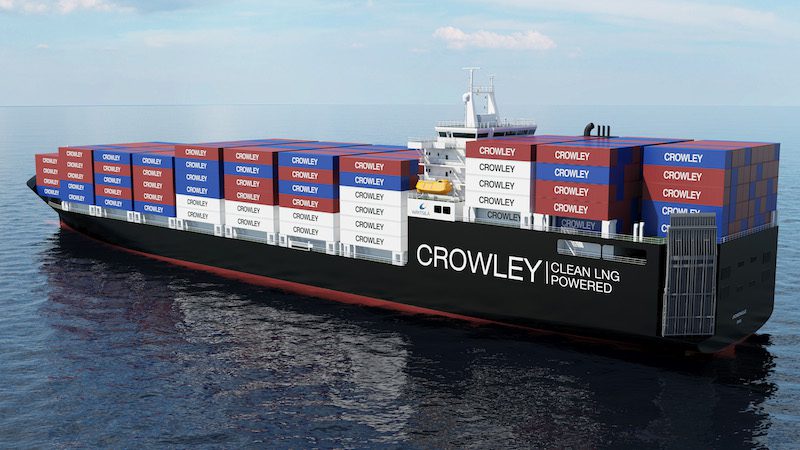
Jacksonville, Florida-based Crowley Maritime Corporation on Monday announced that it has placed groundbreaking order for a pair of LNG-powered RoRo-containerships, becoming the latest in a growing list of U.S. operators opting for clean burning LNG in the Jones Act market.
Crowley said it has signed a contract with VT Halter Marine of Pascagoula, Mississippi to build two of the world’s first LNG-powered ConRo ships to provide Jones Act service between the United States mainland and Puerto Rico.
CrowleyMaritime_CommitmentClass_elcoqui_rear
The so-called Commitment Class vessels are designed to travel at speeds up to 22 knots, carry containers ranging in size from 20-foot standard to 53-foot-long units, and hundreds of vehicles in enclosed, weather-tight car decking. The ships, to be named El Coquí (ko-kee) and Taíno (tahy-noh), are scheduled for delivery in second and fourth quarter 2017 and will replace Crowley’s towed triple-deck barge fleet, which has served the trade continuously since the early 1970s.
“Our investment in these new ships – the first of their kind in the world – is significant on so many fronts,” said Tom Crowley, company chairman and CEO. “We named them the Commitment Class of ships because they represent our commitment to our customers and the people of Puerto Rico whom we will continue to serve for years to come with the superior service they expect from Crowley.”
“Second, it reflects Crowley’s commitment to EcoStewardship© in that we are developing and using best-available technology that allows for improved emissions, advanced ballast water management and alternative fuel selection,” he said. “And lastly, our actions are clear evidence of our commitment to the U.S. maritime industry and the Jones Act. American built, crewed and owned ensures U.S. shipbuilding capabilities, skilled U.S. merchant seamen, and available domestic vessel tonnage, all of which are of vital importance to our national defense.”
The vessel design has been brought to life by Warstila Ship Design in conjunction with Crowley subsidiary Jensen Maritime, a leading Seattle-based naval architecture and marine engineering firm. The new double-hulled ConRo ships have been designed to maximize the carriage of 102-inch-wide containers, which offer the most cubic cargo capacity in the trade. The ships will be 219.5 meters long, 32.3 meters wide, have a deep draft of 10 meters, and an approximate deadweight capacity of 26,500 metric tonnes. Cargo capacity will be approximately 2,400 TEUs, with additional space for nearly 400 vehicles. Crowley says the main propulsion and auxiliary engines will be fueled with LNG.
“When we sat down with Jensen and Wartsila to design these ships, we started with a clean slate to address and incorporate the specific needs of the Puerto Rico market,” said John Hourihan, senior vice president and general manager, Puerto Rico and Caribbean services. “We are very excited to add faster transit times to our existing service offerings while maintaining our ability to handle 53-foot and refrigerated equipment that so many of our customers have come to rely on.”
“We also understand what our car customers want, so we are pleased that these vessels will be the only ones in the trade to offer vehicle transportation in completely-enclosed, ventilated, weather-tight decks,” he said. “Coupled with the LNG fuel, customers can take satisfaction in that they are getting faster, more reliable service, while reducing the amount of CO2 emissions attributable to each container by approximately 38 percent. This design is a win-win for the customer and for the environment.”
“Safety and environmental protection were also at the forefront of our design process,” said Johan Sperling, Jensen vice present. “For example, one of the superior safety systems we engineered included a feature that places all fuel tanks behind double-wall voids with no exposure to the environment.”
Additionally, Sperling said the ships will meet or exceed all regulatory requirements and have the CLEAN notation, which requires limitation of operational emissions and discharges, as well as the Green Passport, both issued by classification society Det Norske Veritas (DNV).
Today’s announced order is the latest display of U.S. owners’ and operators’ appetite for LNG-powered vessels in the Jones Act market, following recent orders for dual fuel containerships from Matson, which has placed orders for two 3,600 TEU vessels at Aker Philadelphia, and TOTE, which has ordered at least three 3,100 TEU vessels from NASSCO in San Diego. In addition, Horizon Lines is also planning to convert two of its steam-powered containerships to the use of dual fuel for operation between Long Beach, California and Honolulu, Hawaii.
While the switch to LNG as a marine fuel in the Jones Act market is mostly praised, some have questioned the high costs associated with building such vessels.
Crowley says that the designing, building and operating LNG powered vessels is very much in line with company’s overall EcoStewardship© positioning and growth strategy. The company formed an LNG services group earlier this year to bring together the company’s extensive resources to provide LNG vessel design and construction management; transportation; product sales and distribution, and full-scale, project management solutions.
Post to  be found at;
http://gcaptain.com/crowley-orders-worlds-first-lng-powered-conro-vessels/?utm_source=feedburner&utm_medium=feed&utm_campaign=Feed%3A+Gcaptain+%28gCaptain.com%29TopOfBlogs

Asean shipowners back emissions monitoring scheme - Hellenic Shipping News Worldwide

Posted - November 26, 2013 - Hellenic Shipping News Worldwide

The Federation of Asean Shipowners' Associations (Fasa) is looking to develop a scheme at the IMO level for the monitoring of carbon dioxide emissions and fuel consumptions by ships.

Fasa, at its 39th annual general meeting last Friday, said that any requirements to establish a global system for the monitoring and reporting of fuel consumption for international shipping must be agreed upon at the IMO level as a way to secure internationally acceptable and harmonised system.

The meeting, however, could not support any proposals calling for the verification of data collected as this would place an unacceptable financial burden on shipowners.

The meeting further emphasised that its acceptance of a monitoring and reporting mechanism does not automatically imply its acceptance of it being used for the eventual development of any market-based measures, or the mandatory application of energy efficiency improvement measures or indexing for existing ships.

Meanwhile, Fasa noted there had been a general decline in the number of piracy and armed robbery attacks worldwide, but it remains deeply concerned that pirate attacks in the Gulf of Guinea have worsened and became more violent.

“I strongly urge the littoral states bordering the Gulf of Guinea, as well as those bordering the Straits of Malacca and Singapore, to put a stop to these criminal activities immediately as they pose a real danger to the safety of seafarers and ships navigating through these pirate infested waters,” said Nordin Mat Yusoff, chairman of Fasa.

“Fasa expects all these littoral states to increase naval and enforcement surveillance in these waters immediately to deter further pirate attacks,” he continued.
Source: Seatrade Global 

Post to be found at:
http://www.hellenicshippingnews.com/News.aspx?ElementId=885bc033-9ef6-4921-8b33-15fe6b2813c8&utm_source=newsletter&utm_medium=email&utm_campaign=daily
TopOfBlogs

USA - California Air Resources Board 2014 Amendments to the Ocean Going Vessels Fuel Rule - Hellenic Shipping News Worldwide

Posted - November 26, 2013 -  Hellenic Shipping News Worldwide

Members are reminded that from 1 January 2014 the California Air Resources Board (CARB) Ocean Going Vessels (OGV) Fuel Rule Phase II fuel requirements will enter in to force.  The maximum permitted sulphur content of Marine Gas Oil - MGO (DMA) and Marine Diesel Oil - MDO (DMB) used by ocean going vessels within Californian waters will reduce from 1.0% and 0.5% sulphur respectively to a maximum of 0.1% sulphur for both fuel types.

Members are advised to review the guidance contained in CARB Marine Notice 2013-1 and ensure their vessels comply with the updated distillate fuel oil sulphur limits from 1 January 2014 when within Californian waters. Further details of the requirements of the CARB OGV Fuel Rule can be found in the following news articles:

    USA – California Air Resources Board Amendments to the Ocean Going Vessels Fuel Rule
    USA – California Air Resources Board Amendments to the Ocean Going Vessels Fuel Rule - Update

Vessels complying with the CARB OGV Fuel Rule must also adhere to the maximum fuel oil sulphur requirements of the MARPOL Annex VI North American Emission Control Area as both sets of regulations apply. Details can be found in the Club’s news article: MARPOL – North American Emission Control Area.

Members requiring any further guidance should contact the Loss Prevention Department.
Source: West of England P&I Club 

Post to be found at:
http://www.hellenicshippingnews.com/News.aspx?ElementId=ff2dfd06-441d-4b54-a96f-102db24e581e&utm_source=newsletter&utm_medium=email&utm_campaign=daily
TopOfBlogs